
WordPress · 5 min read
How to Choose the Right Solution for Your Business
Aug 10, 2026 · Macrohire IT Solutions
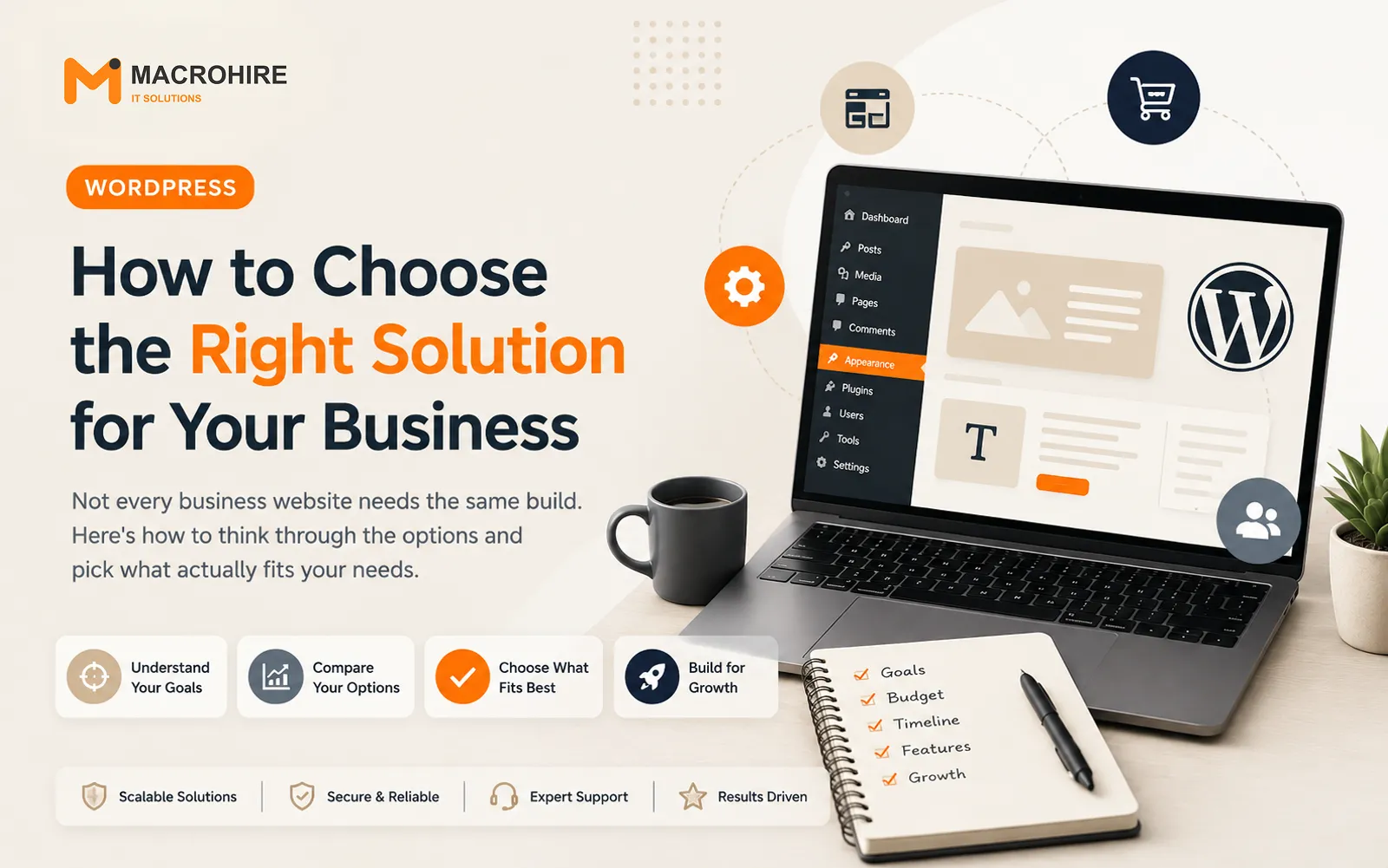
Every business owner eventually faces the same question: what kind of website or platform should we actually build? Between website builders, custom themes, and fully custom development, the options can feel overwhelming, especially when every vendor claims their approach is the right one. The truth is that the best solution depends entirely on your business, not on trends or what a competitor did.
Start With Your Business Goals, Not the Technology
Before discussing platforms, themes, or plugins, get clear on what the website actually needs to do. Are you generating leads, selling products directly, showcasing a portfolio, or supporting an existing sales team? A local service business with a simple contact form has very different needs than a company selling hundreds of products online. Writing down your top three goals before any technical conversation happens will save you from paying for capability you don't need, or worse, ending up with a site that can't do what your business requires.
Weigh Flexibility Against Simplicity
WordPress is popular precisely because it sits in a comfortable middle ground: it's flexible enough to support complex functionality, yet simple enough that a non-technical team member can update content without calling a developer every time. A pre-built theme with light customization is often enough for a business that just needs a professional presence online. A more custom build, using WordPress as a foundation with tailored functionality, makes more sense when you have specific workflows, integrations, or user experiences that off-the-shelf options can't handle.
The key question isn't "what's the most powerful option available" but "what's the simplest option that still meets our actual requirements." Over-engineering a website adds cost and maintenance burden without adding value.
Think About Growth, Not Just Launch Day
A solution that works well at launch can become a limitation a year later if it wasn't chosen with growth in mind. Consider how your business might change: will you add an online store, expand into new markets, integrate a booking system, or need multilingual content? You don't need to build all of that on day one, but choosing a platform and structure that can accommodate it later avoids a costly rebuild down the line. This is one of the reasons WordPress remains a strong choice for many businesses: its plugin ecosystem and open architecture mean new capabilities can usually be added without starting from scratch.
Get an Honest Technical Opinion Before Committing
It's easy to get pulled toward whatever solution a single vendor happens to specialize in. A more useful approach is to describe your goals, budget, and timeline to a development team and ask them to walk you through the trade-offs of different approaches, including ones they might not build themselves. A team that's upfront about what a simpler option can and can't do, and honest about when custom development is genuinely necessary, is far more valuable than one that pushes the most expensive path by default.
Wrapping up
Choosing the right website solution comes down to matching the platform to your actual business needs, both today and a few years out, rather than chasing the most advanced option available. Take the time to define your goals clearly, understand the trade-offs between simplicity and flexibility, and get an honest technical perspective before committing to a direction.
More articles.
View all →

Have a project in mind?
Tell us what you're building. We'll show you how we'd approach it.